
Green Star Fitouts is here!
Key Takeaways
At the annual TRANSFORM Conference this March (2026), the Green Building Council of Australia officially launched the new Green Star Fit Outs tool, marking a significant evolution in how workplace sustainability is understood and delivered across Australia and New Zealand.
The latest iteration of Green Star Fit Outs introduces several key advancements:
Minimum Expectations define what sustainable fitouts must achieve
These credits are mandatory and do not earn points, and without them, a project cannot be certified. For 4 Star, meeting them is the core requirement; for 5 and 6 Star, they sit underneath the wider Climate Positive Pathway and point thresholds. We dive deeper into the Minimum Requirements requirements of each Category below.
There is a stronger focus on upfront carbon
In line with other ‘Future Focus’ tools, there is greater emphasis placed on embodied emissions, encouraging project teams to consider material selection, reuse and lifecycle impacts earlier in the design process.
Health and wellbeing outcomes are embedded throughout
A greater number of credits are aligned with occupant outcomes, reinforcing the importance of indoor environment quality, thermal comfort and access to healthy materials.
Circular economy principles are leading the way
The GBCA is leading global best practice in designing the ‘Circularity’ category. This category is made up of credits promoting designing for disassembly, adaptive reuse and waste minimisation - shifting fit outs away from short-term, high-waste cycles.
Responsible products and supply chains both get a boost
The Responsible Products category applies value to product transparency and performance, so companies that are investing in better products and supply chains are rewarded.
There are number of key implications of the new tool, but preparation and timely application are absolutely fundamental. Project teams must address the mandatory requirements during briefing and concept design stages - any later could mean a project misses out on certification entirely.
Why the update?
The Fitouts tool is the last of the ‘Future Focus’ updates, however it is by no means the least important! Fitouts are among the most frequently replaced elements in the built environment, typically cycling every 5–7 years. Emerging research shows that each replacement cycle carries substantial carbon, waste, health and cost implications that have historically been underexamined - with fitouts contributing up to 32% of a commercial building’s total emissions.
The new tool matters as its not just a refresh. It has totally revamped its categories with its focus around six categories: Circular, Responsible, Healthy, Positive, People and Leadership. Its Circular category is a world-first, and a crucial step forward in embedding circular principles within fitout design and delivery.
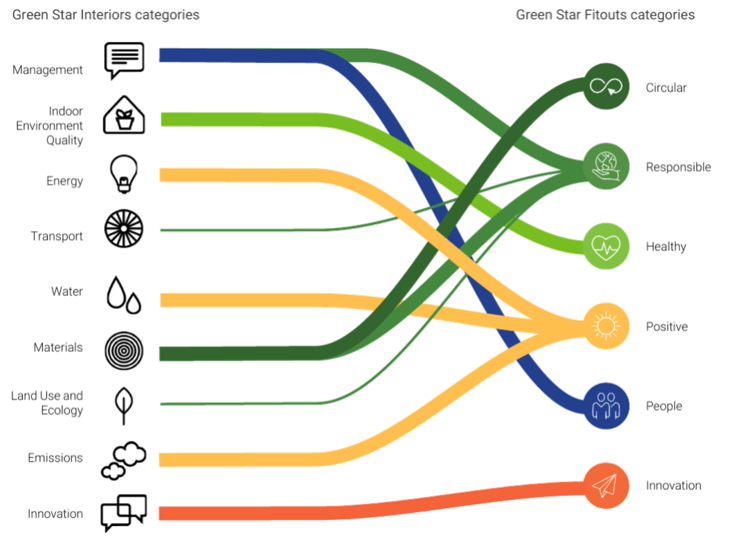
Green Star Categories Transition
What is new?
The most critical aspects of the new tool is the introduction of the Minimum Expectations, as it does not matter how strong the rest of the submission is, if these are not met - certification is off the cards.
The points scoring within the tool is different. Addressing all of the Minimum Expectations is sufficient to meet a 4 Star rating, whilst 5 Star and 6 Star projects must meet all Minimum Expectations, the Climate Positive Pathway requirements, and then achieve at least 20 points for 5 Star or 45 points for 6 Star.
The Climate Positive Pathway is a defined set of mandatory credits within the Positive category that include progressively more stringent credit requirements aligned to a project’s registration date and targeted star rating. They move fitouts from baseline measures such as all-electric fitouts and energy efficiency, through to renewable energy procurement, upfront carbon reduction, and ultimately carbon compensation. While some credits offer stepped improvements, projects must meet the full threshold at each performance level to comply.
What do these Minimum Expectations mean in practice?
The below summarises the key aspects of the Minimum Expectations within each category.

Circular Category
The baseline requirement is a reuse assessment - a step to be considered before strip-out and before design decisions are locked in. The assessment must identify opportunities to integrate reused elements in the fitout, and for existing sites it includes reviewing what can be retained on site as well as what might be sourced second-hand or reused from elsewhere.
Our Advice
The practical advice here is straightforward: audit early, before demolition packages are finalised, and treat retain-and-reuse decisions as design inputs, not post-rationalisations.

Responsible Category
The first shift is that material outflows must be reported. This pushes projects away from vague waste claims and toward documented tracking of what leaves site, in what quantities, and where it goes.
The second shift is handover. Commissioning and editable operations and maintenance information are both mandatory, which means fitout performance cannot stop at practical completion.
Our Advice
Our advice is to set the material reporting framework before strip-out begins, and to build commissioning and O&M obligations into consultant scopes and trade packages early rather than trying to assemble them at the end. An Independent Commissioning Agent is not mandatory, but the guidelines note that one may be advantageous on large or complex projects.

Healthy Category
Previously known as “Indoor Environment Quality”, the Fitouts tool has rebranded it to “Healthy” in alignment with the tool’s intent to promote fitouts that focus on and improve the physical and mental health of occupants. While Interiors v1.3. rewarded good indoor environments, Fitouts establishes that all occupants be provided with Clean Air, high quality Light, Acoustic and Thermal comfort, and Low Toxin Materials as a baseline, and encourages improvements based on these.
Our Advice
To ensure all minimum expectations are met, project teams should incorporate ‘Healthy’ considerations from pre-design rather than retrospectively. Including planning for protection and/or cleaning of ductwork prior to occupation, early specification of compliant lighting and low-toxin materials and integrating acoustic and thermal comfort into core design decisions as opposed to supplemental targets.

Positive Category
Positive incorporates Energy, Water and Upfront Carbon Emissions into one category. Fitouts are now expected to be fully electric, meet one of three Energy Efficiency pathways, utilise WELS rated fixtures and appliances that meet or exceed thresholds, and demonstrate an Upfront Carbon Reduction of at least 10% as compared to a reference fitout. In effect, this means electrification, efficiency and upfront carbon are no longer “nice to have” leadership themes. They are baseline certification concerns.
Our Advice
Base building selection is now critical, so our advice is encourage an efficient building where possible. Next, lock in the water and efficiency requirements in procurement schedules, and tackle embodied carbon where it matters most in fitouts - furniture, partitions and joinery. Retain and reuse should be the first move, with low-carbon substitutions coming after that.

People Category
Finally, the People category introduces two mandatory requirements that are easy to underestimate.
Construction Site Culture requires inclusive amenities and PPE, along with on-site policies addressing respectful behaviour, reporting, drug and alcohol awareness, and mental health.
Design for Equity requires an early equitable design review and at least three implemented design features that respond to accessibility, universal design, neurodiversity, sensory needs, and wayfinding or communication.
Our Advice
Our advice is to discuss the requirements with the Head Contractor to ensure site culture requirements are included within the prelims, site establishment and induction processes start from day one, and the project runs the equitable design review early enough to influence layout, signage, acoustic conditions, lighting and refuge or low-stimulation spaces.
Summary
The latest Green Star Fitouts tool marks a shift toward more rigorous, forward-looking standards that embed net zero readiness and whole-of-life thinking into design and construction. Here at Rewild, we have already benchmarked the uplift against the legacy Interiors v1.3 methodology, and we are enjoying embedding it into our progressive clients’ projects.