
Off-grid ≠ Sustainable Practice
Lessons from modelling a Living Building Challenge (LBC) aligned home in Victoria.
Key takeaway
“Off-grid” can increase cost and embodied carbon at single-home scale by forcing oversized PV and battery systems sized around the worst winter week. Where services exist, a grid-connected, net-positive approach (with islanding and critical-load backup) often delivers better sustainability outcomes.
Background
Off-grid is often equated with sustainability. For a single dwelling in Victoria pursuing Living Building Challenge (LBC) outcomes, we were asked to size PV and battery storage to meet an off-grid brief and approximately one week of energy resilience. We expected the model to refine the system. Instead, it highlighted a structural issue: the off-grid constraint can drive material-intensive solutions that deliver limited additional benefit when a grid connection exists.
What we did
We built a one-year, hourly energy simulation to test performance across seasons and to explicitly stress-test winter. Hourly modelling matters because off-grid systems fail on time mismatch: multi-day runs of low solar generation combined with high heating demand, not on annual energy totals.
As a starting point, we assumed the roof PV was maximised (approximately 78 kW), then iterated battery sizing and operating assumptions against a resilience intent: keep the home habitable and maintain critical services through a one-week low-generation period. Early consultant sizing suggested that 160 kWh of storage would be sufficient, but that estimate relied on simplified, non-hourly assumptions rather than a full-year, hour-by-hour stress test of winter conditions using a representative weather year.
Figures 1 and 2 show the simulated battery state-of-charge during June (a representative winter month) for two storage capacities.
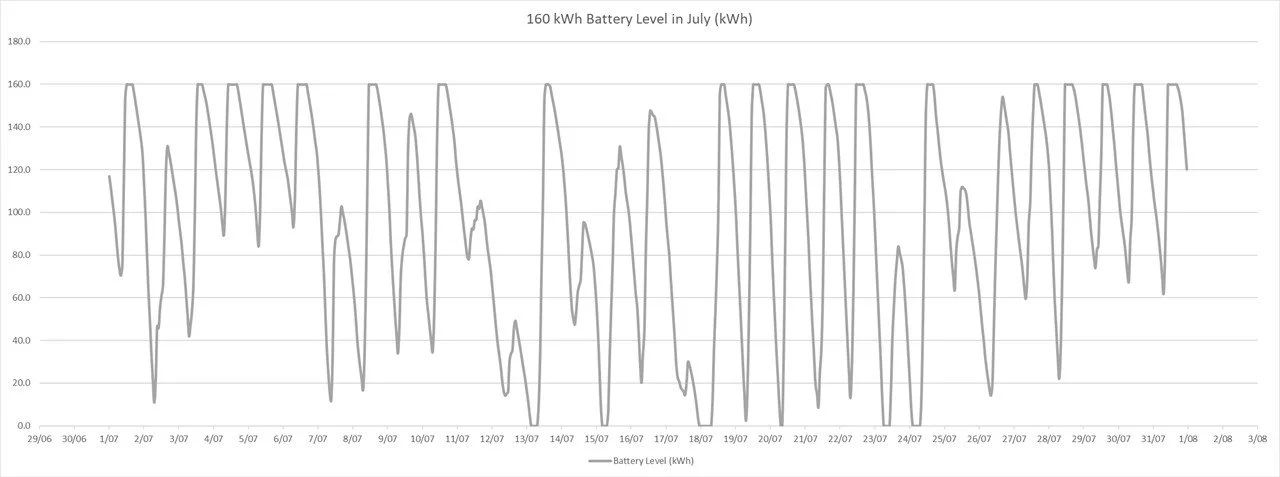
Figure 1. Initial consultant sizing (160 kWh). When tested with one-year hourly modelling, the battery repeatedly depletes to zero in June, indicating the system cannot sustain critical loads through the limiting winter sequence.
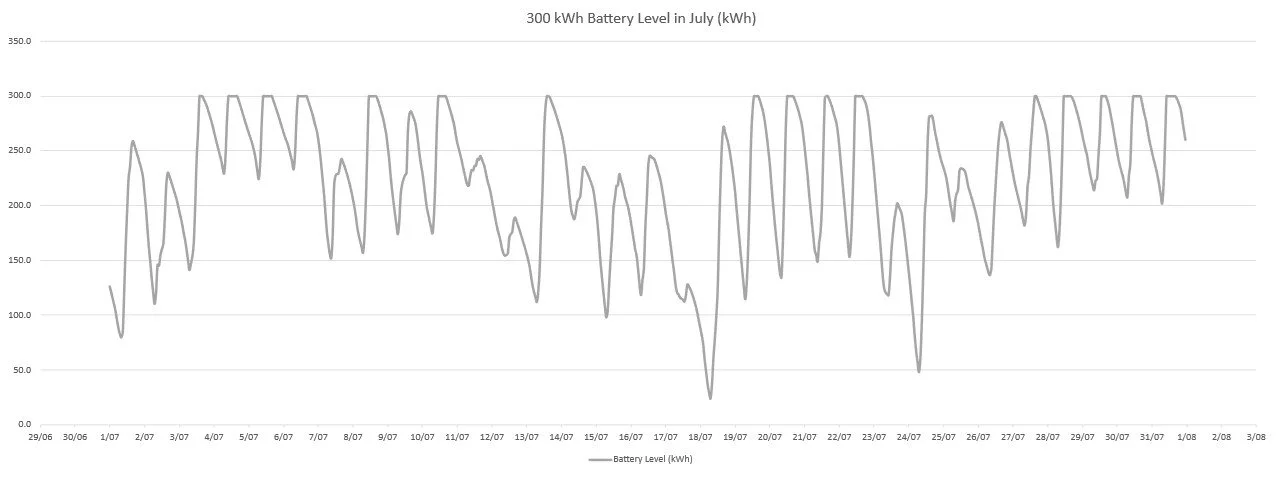
Figure 2. Minimum modelled storage to satisfy the one-week habitability resilience intent (300 kWh). Increasing storage reduces the frequency and duration of depletion events, but highlights how sizing for winter resilience drives large batteries.
What we found in Victoria: the “worst week” problem
In Victoria, the limiting case is winter: solar yield is lower and heating demand is higher. When you size for the worst winter week, you are effectively designing for a combination of low generation and high demand.
That creates two compounding effects:
You need substantial storage to ride through several cloudy days while maintaining habitable conditions.
To reliably refill that storage after the event, the PV array typically becomes very large, so large that in milder seasons the batteries reach full charge early and surplus PV is “spilled” (curtailed) because there is nowhere for it to go off-grid.
In plain terms: you pay (financially and in embodied carbon) for panels and batteries sized for a short winter bottleneck, and you can’t fully use that capacity for much of the year.
Why passive design changes the answer
The most reliable way to reduce PV and battery size is to reduce winter demand. Passive design and envelope performance usually offer the highest leverage:
Orient key living spaces for winter sun and control glazing areas by facade.
Specify high-performance glazing appropriate to climate (U-value, SHGC) and detail shading for summer.
Increase insulation where it materially reduces heat loss and manage thermal bridges.
Prioritise airtightness and good ventilation strategy (including heat recovery where appropriate).
Use thermal mass intentionally and plan for natural cross-ventilation and night purge where climate supports it.
Do this first and the PV/battery can be smaller, comfort typically improves, and resilience is higher during cloudy spells because the house holds temperature longer.
Grid connection: the lower-impact option
This project reinforced a difficult point: there can be a real misalignment between “off-grid” and sustainability. If grid and reticulated services are available, a grid-connected net-positive approach can reduce overall material, cost and embodied carbon while still enabling resilience.
Two practical implications:
Exporting PV to the grid allows surplus generation to be used rather than curtailed, improving the value of installed PV.
With a grid connection, resilience can be targeted: islanding capability plus critical-load backup can cover outages without oversizing for rare winter weather sequences.
If you are evaluating a site (or buying land), add this to the due diligence: choose locations with enough grid connection and PV export allowance (network export limits vary) so surplus generation can be injected to the grid rather than wasted. This can materially reduce the required battery size.
Water has similar trade-offs
Off-grid thinking often spreads beyond electricity. Under LBC-aligned goals, projects may target rainwater harvesting, on-site treatment, and reuse strategies. At single-home scale, that can introduce additional storage, pumps, treatment plant, monitoring and maintenance. Where reticulated services exist, the same sustainability logic applies: shared infrastructure can reduce the amount of equipment each home needs to build and operate.
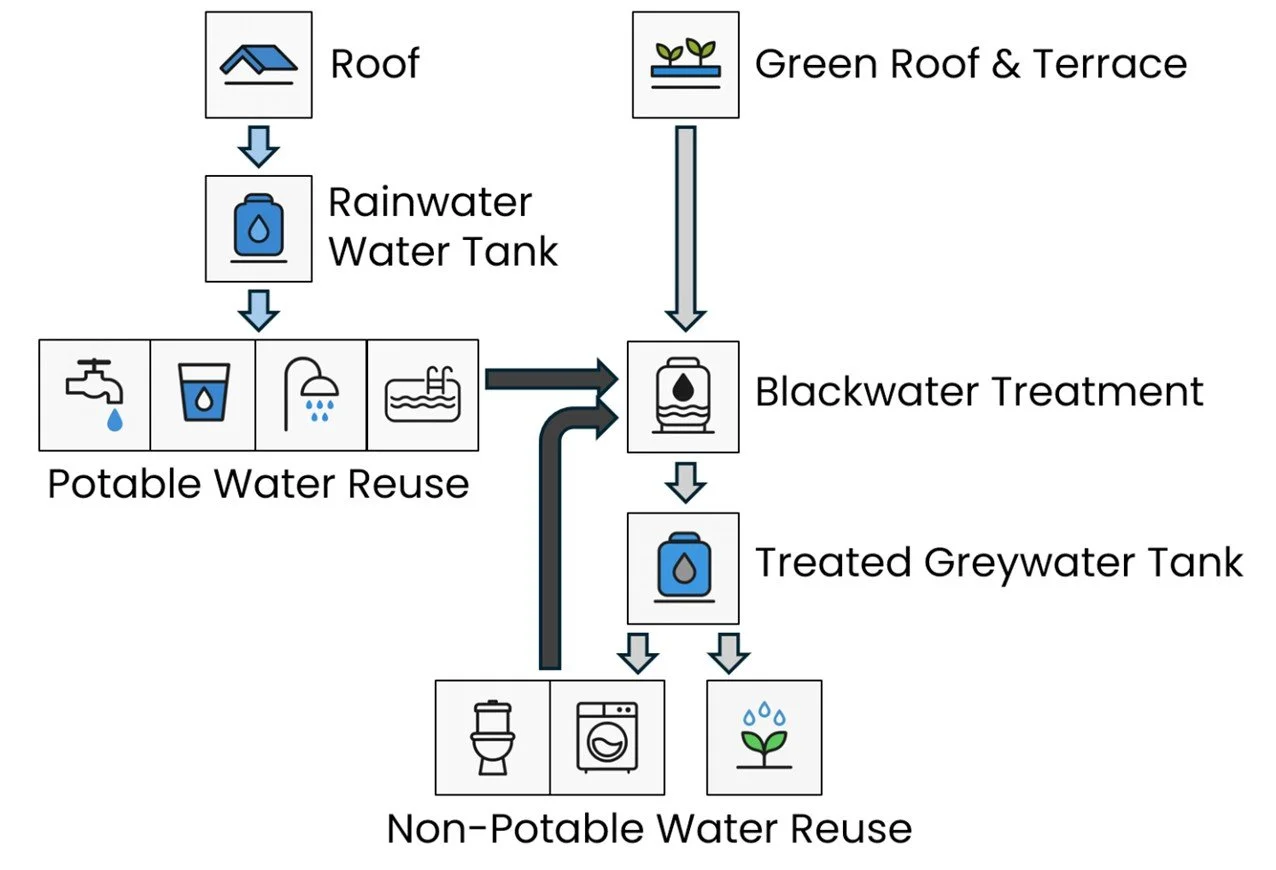
Figure 3. Schematic: Rainwater supply for potable reuse, with blackwater treatment and treated greywater storage for non-potable reuse.
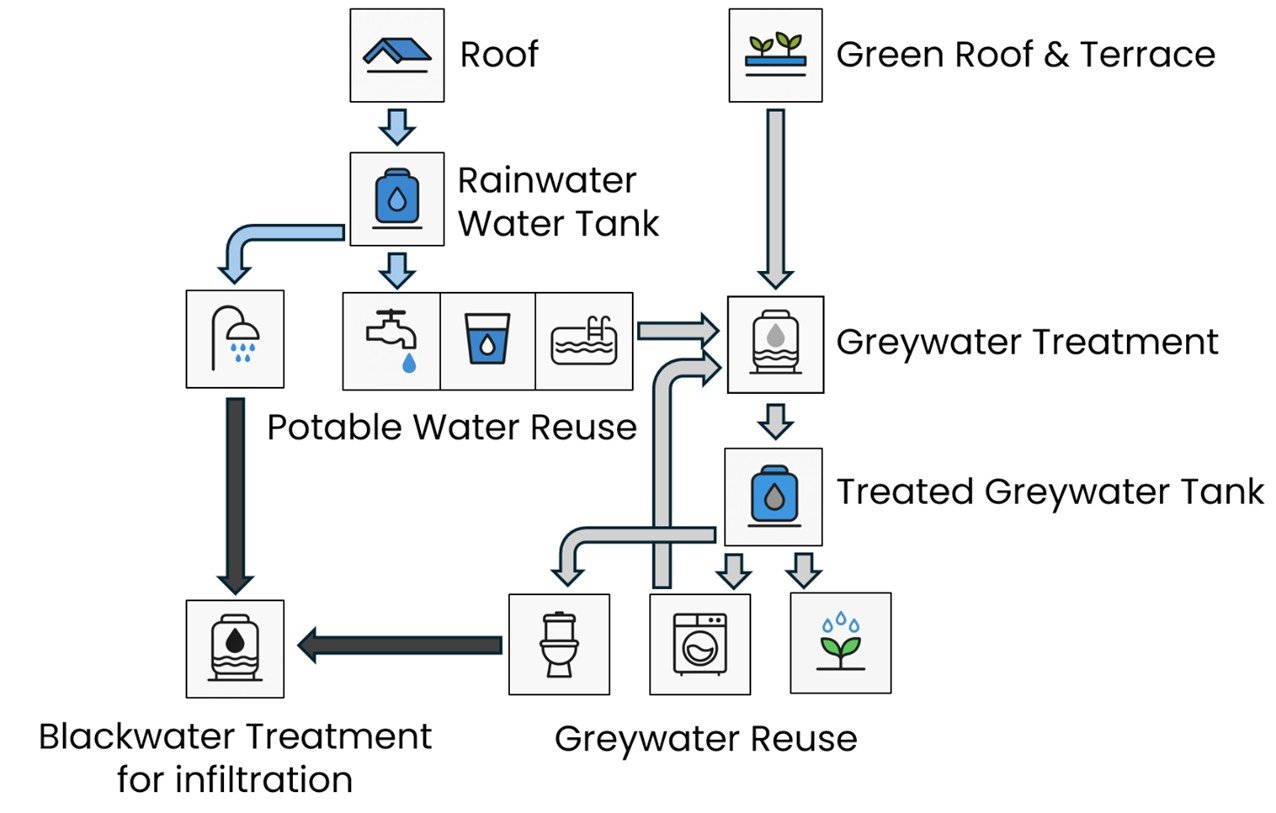
Figure 4. Schematic: Alternative water loop with greywater treatment and reuse, and blackwater treatment for infiltration.
What we’d recommend for any “off-grid” brief
If we could condense the experience into a process checklist, it would be:
Challenge the premise first. If a grid and reticulated services are available, consider a grid-connected, net-positive approach (with islanding and critical-load backup) rather than full off-grid. Where you have a choice of sites, prioritise a grid connection with sufficient export allowance to accept PV generation.
If off-grid is unavoidable, reduce demand before adding hardware. Use a clear hierarchy: passive first → efficient systems → PV → storage last.
Model hourly, not annually. Explicitly test the worst winter sequences (low solar plus high heating demand) and confirm battery state-of-charge behaviour over multi-day cloudy periods.
Define resilience in operational terms. Separate critical loads (food safety, lighting, communications, minimum heating) from comfort loads, and set a realistic definition of “habitable” for the resilience period.
Quantify curtailment (wasted solar). If batteries are full for long periods and surplus PV has nowhere to go, treat it as a red flag that the system is being sized around rare events.
Use load-shifting strategies before more storage. Examples include east–west PV orientation to better match household demand, hot-water preheating during solar hours, and smart scheduling of discretionary loads.
Bring embodied carbon into the conversation early. If storage requirements are growing rapidly, test whether demand reduction, load shifting and grid connection can achieve the same resilience with far less equipment.
Closing thought
Off-grid can be the right answer for genuinely isolated sites. But where a grid connection exists, “off-grid” is not automatically sustainable. Too often it shifts impact from operational energy to materials, cost and underutilised capacity. The most durable pathway we saw was to design the building to need less in winter, then size PV and storage against a clearly-defined resilience target—preferably with a grid connection that lets surplus generation do useful work.