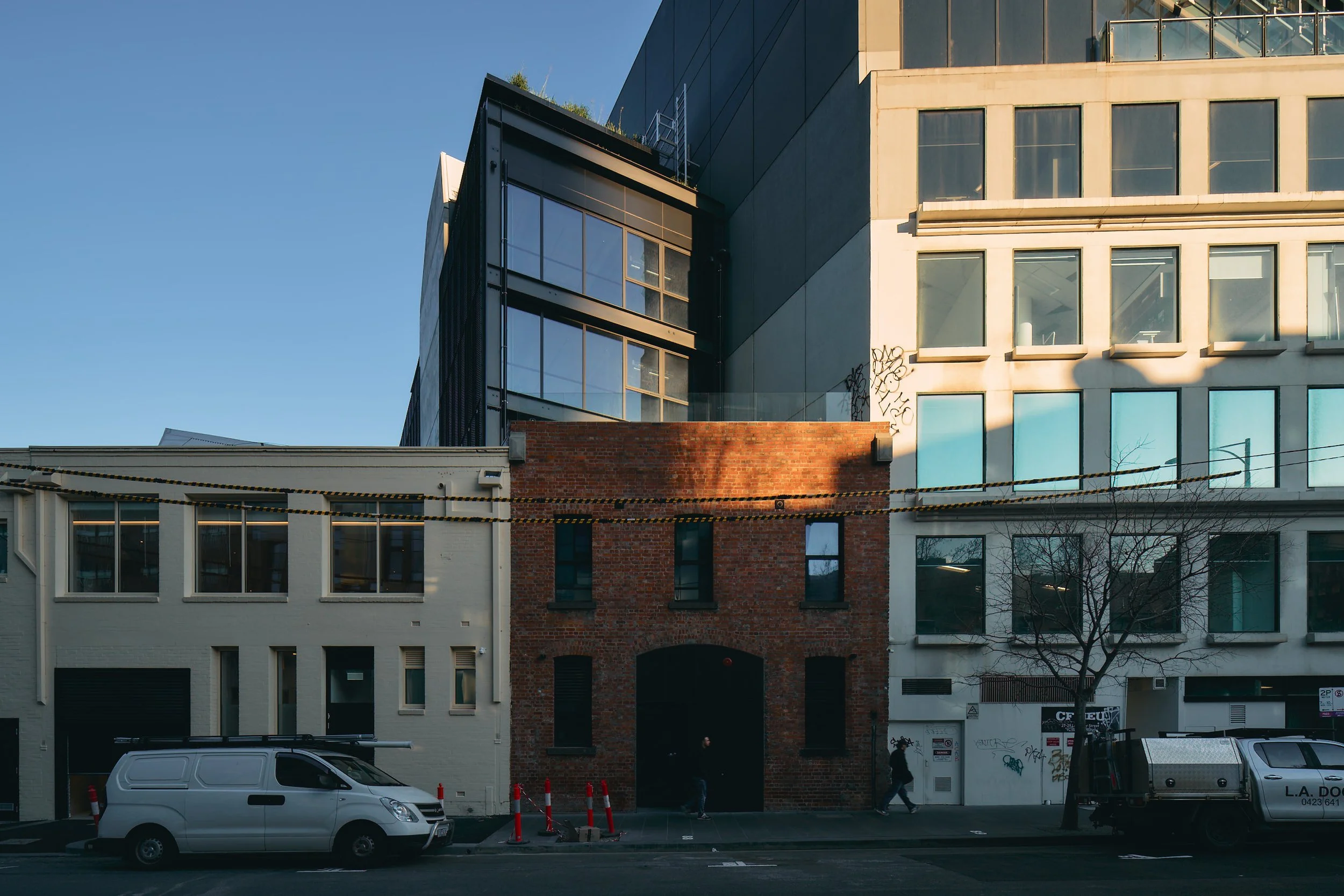

27 - 29 Leicester Street -
Life Cycle Analysis
Project Details
SERVICE OFFERING:
CLIENT:
CLIENT INDUSTRY:
LOCATION:
DELIVERABLES:
ESD - LCA
27-29 Leicester Street
Construction
Melbourne, Australia
Life Cycle Analysis (LCA) in line with Green Star’s Upfront Carbon Emissions credit
“Through Rewild’s rigorous LCA process, the project exceeded the previously targeted ‘Minimum Expectations’ within Green Star Buildings, to achieve ‘Credit Achievement’ - unlocking outcomes that were not originally targeted and materially improving the project’s embodied carbon performance.”
— Project Team member
Project Overview
The development of 27-29 Leicester Street, Carlton saw the creation of a new Health and Development Centre that contained five distinct areas that were designed to cater to specific needs of the buildings’ user groups. These areas include culturally sensitive spaces for women and indigenous members, a state-of-the-art gym / rehabilitation space for injured members returning to work, and a versatile multi-purpose space for functions and events.
Rewild Agency undertook a comprehensive Life Cycle Analysis (LCA) and Upfront Carbon Emissions assessment for the 27–29 Leicester Street development to support its Green Star Buildings submission. The analysis quantified embodied carbon across all key building elements, identifying opportunities to minimise emissions and align with Green Star’s Upfront Carbon Reduction (Credit 24) credit requirements.
Key Initiatives to Achieve Embodied Carbon Reduction
Structure: optimised concrete mix with 30%+ SCM replacement in key elements.
Façade: high recycled-content aluminium framing and low-E double glazing.
Interiors: FSC-certified timber, low-VOC finishes, and modular joinery.
Environmental Product Declarations (EPDs): Use of products with EPDs allowing modelling of product value chain improvements and reductions.
Recycled Products: Use of recycled timber in interior finishes.
Local Products: Procurement of Australian-made products over international alternatives.
Our Methodology
Collected material quantification data from sources such as REVIT modelling outputs and reported material use as per subcontractor actual use on site.
Utilised online software e-tool (developed by Cerclos) to model the Reference Design upfront carbon, and the Proposed Design (including design and efficiency improvements) upfront carbon.
Conducted a cradle-to-practical completion LCA in accordance with ISO 14040/44 and Green Star Buildings Technical Guidance.
Modelled A1–A5 life-cycle stages, focusing on structural, façade, concrete mix design improvements and fit-out components.
Benchmarked results against the Green Star Buildings reference model to identify reductions in embodied carbon intensity (kg CO₂-e/m² GFA).
Applied recognised Australian data sources (e.g., EPD Australasia, ISCA Materials Calculator, Thinkstep GaBi) for product-level inputs – including both EN 15804+A2 and EN 15804+A1 indicators.
Rewild Agency’s Impact
Achieved a 28% reduction in upfront carbon relative to a ‘Reference Building’.
Exceeded the projects target of achieving Green Star’s ‘Minimum Expectations’ of a 10% reduction in embodied carbon into ‘Credit Achievement’ due to extensive modelling and iterative feedback.
Contributed to the buildings 5-Star Green Star Buildings certification target.
Project Timeframe
April 2022 – Dec 2025